
Step 1: Access Payors Menu


- Navigate to “Payors” in your menu toolbar

Step 2: Add New Payor
- Note that “Private Pay” is added as a default service and will need to be updated to meet your agency setup. Private Pay is used for any client without an authorization and is separate from a client contact payer
- To add a new payor, select “Add New” in the top right corner of your screen. A Payor pop-up window will appear

Step 3: Complete Payor Information
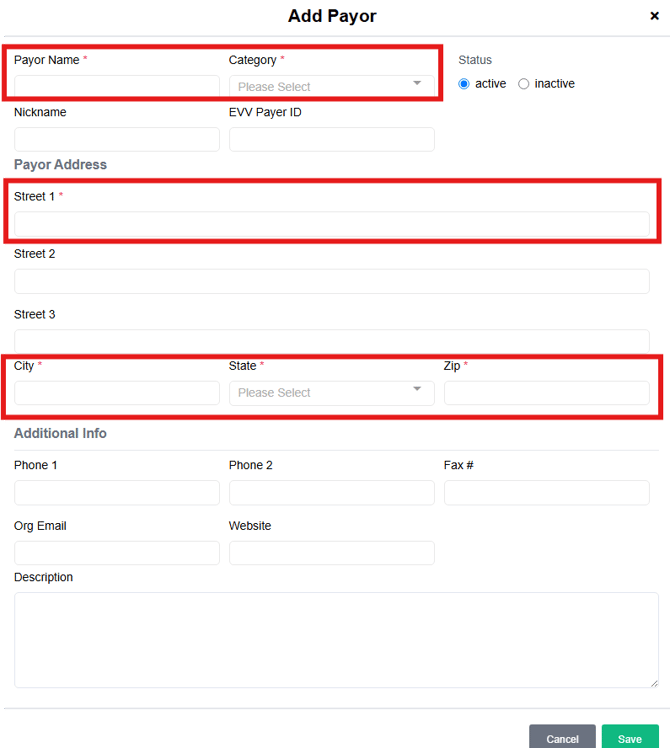
- At minimum, complete the following information in the pop-up window:
- Payor Name
- Category
- Street Address
- City
- State
- Zip
- If you are submitting claims using EVV, additional fields may be required, including EVV Payer ID
Step 4: Save Payor
- Once you’ve completed the information, select “Save”
- Please repeat these steps to add additional payors as needed
Update your Payor’s Billing Settings
Step 1: Access Payor Menu
- Navigate back to Payor
Step 2: Select Payor
- Click on the name of the payor you wish to set up billing for

Step 3: Navigate to Billing Settings
- You will be brought to the “Services & Rates” page
- Select “Billing Settings”, which is next to “Services & Rates” in the submenu of the billing menu

Step 4: Complete Billing Settings:
- Complete the Billing Details for the specific payor:

-
- Frequency = select the frequency this payor will be billed
-
- Billing Identifier = which ID will be used to identify the client
- Place of service = optional
- Payor Export Template = select the preferred export template (this will typically line up with Payor Type)
- EDI Receiver & Payor IDs = If EDI is selected as a template, these will unlock and you may enter the required information
- The Other Settings and Financial Settings are optional; review each setting and select if needed.
- Click Save when complete. Once saved, you will be able to utilize this payor for authorizations and billing
- Repeat these steps for each payor
If needed, complete Care Programs & Case Managers: Care Programs and Case Managers can be added to Authorizations after entry in this area.
- Select Add New, complete the form and save

Add Case Managers:
Navigate to Case Managers

Select Add New, enter information and Save

Assign your Services & Rates
Step 1: Access Payor
- Within your “Payors” tab, click on the name of the payor you’d like to add services and rates to.

Step 2: Add New Service
- You’ll be brought to the “Services & Rates” tab by default
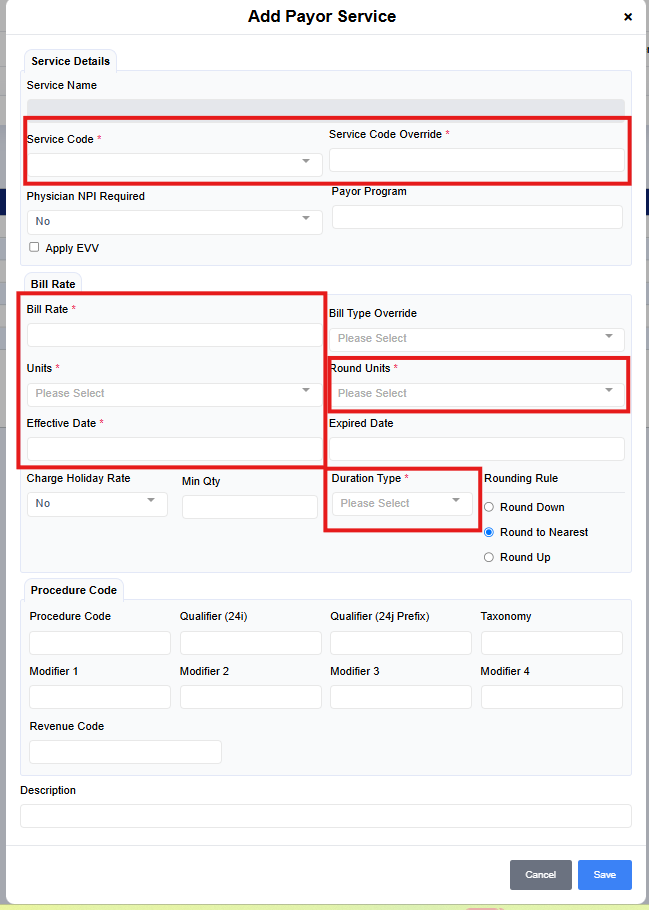
- In the top right corner of your screen, select the “Add New” button. The “Add Payor Service” pop-up window will appear
Step 3: Complete Service Information
- At minimum, please add the following fields:
-
- Service Code: The abbreviation of the service you’d like to add (i.e Personal Care = PC)
- Bill Rate: The amount you bill for performing this service
-
- Units: The unit of measure on how your bill rate calculates (per hour, per 15 minutes, etc.)
- Duration Type: Select if the service duration type Electronic (actual clock in and out time with no rounding) or Official (included rounding rules)
-
- Round Units: Your Rounding units must be less than or equal to your billing units.
- Rounding Rule: The rounding rule is applied to your selected rounding units.
- Round Down - Rounds down to the prior rounding unit value.
- Round to Nearest - Rounds to the nearest Rounding Unit value.
- When using 15 minute rounding units, this follows the same rounding rules as the Payroll (EVV) rounding. Minutes 1-7, round down, 8-14 round up.
- Round Up - Rounds up to the next rounding unit value.
-
- Effective Date: The date that the service rate applies to. We highly recommend making the effective date immediately or backdated. Applying a start date in the future will block users from scheduling for visits prior to this effective date
- Additional areas maybe required based on your payor and submission type. Verify with your aggregator on what fields are required.
- Once complete, select “Save”
- Repeat these steps for each service under each payor